
 MarketingShot

Hi there, this is your daily ☕️ MarketingShot.
In today's MarketingShot:
🎬 YouTube finds creators now use AI to express identity
⚠️ Meta makes you liable for its AI ad edits on October 30
📉 Your ad returns shrank even as spend doubled, Metricool finds
🎨 Canva's new Craft model builds marketing images you can edit
📺 LinkedIn now lets you target streaming TV ads in the US
Plus: 💡 6 strategies & tactics, 🎁 6 more stories you might like, and 🧰 6 tools.
YouTube finds creators now use AI to express identity LINK
- YouTube's Human Creativity and AI report found that creators and hobbyists now use generative AI video to explore identity, show emotion, and join shared interests, rather than treating the technology mainly as a way to make content faster.
- The research, run with NRG among thousands of online people aged 14 to 44, found that 72% of surveyed video posters use AI on videos or images, and more than two-thirds of AI video posters have featured themselves in that content.
- Trends like "hug your younger self," where creators animate childhood images, turn private feelings into shared social moments, which means platforms and brands will need to treat generative video as social expression, not just a production feature.
Meta makes you liable for its AI ad edits on October 30 LINK
- Starting on October 30, 2026, advertisers on Facebook and Instagram will be "solely responsible" for anything Meta's AI features create or alter in their ads, under Meta's revised Commercial Terms, even for features Meta switches on itself.
- Adweek found a new "AI Features" section in the terms that extends liability whether or not the advertiser opted in, a shift from earlier wording that applied only when a business chose to use the Ad Creative AIs.
- Agencies say Meta's tools already add sitelinks, translate copy and generate images in live campaigns without permission; the one exit is to stop running ads, since continued use after October 30 counts as agreement.
Your ad returns shrank even as spend doubled, Metricool finds LINK
- Metricool's 2026 Social Media Ads Report found that return on ad spend fell from $5.48 to $4.57 in a year, even as advertisers more than doubled their spending.
- Over the same period, total revenue grew from $344.8 million to $694.4 million, so advertisers brought in more money overall while each dollar spent returned less than before.
- The largest accounts posted a ROAS of just $3.96, lower than even the smallest ones, which the report ties to audience saturation, rising acquisition costs, and diminishing returns as campaigns scale.
Canva's new Craft model builds marketing images you can edit LINK
- Canva has launched Craft, an image generation model built in-house for design work, that makes marketing graphics which stay editable inside its platform rather than fixed, flattened pictures.
- Craft runs in two stages: one model turns a prompt into a plan for visual hierarchy, placement, scale and typography, then a second model renders the image, producing 2K output across more than 30 aspect ratios.
- Craft is available now in Dream Lab and through Canva's public API, while Canva MCP support, plus faster Craft-fast and Craft-ultrafast variants, is still coming, so it does not yet work inside every third-party assistant.
LinkedIn now lets you target streaming TV ads in the US LINK
- LinkedIn has opened its Connected TV advertising to programmatic buying through Google's Display & Video 360, so advertisers can apply its professional targeting, such as job title, industry and seniority, to streaming inventory inside Google's demand-side platform.
- The route works only for United States audiences, and buyers reach business decision makers across premium streaming inventory through Microsoft Monetize, with LinkedIn supplying the audience data and Display & Video 360 acting as the buying interface.
- Access is not self-serve, requiring advertisers to contact a LinkedIn or Google account representative, and neither company published pricing, minimum spend or audience size terms for this specific route.
From our partner
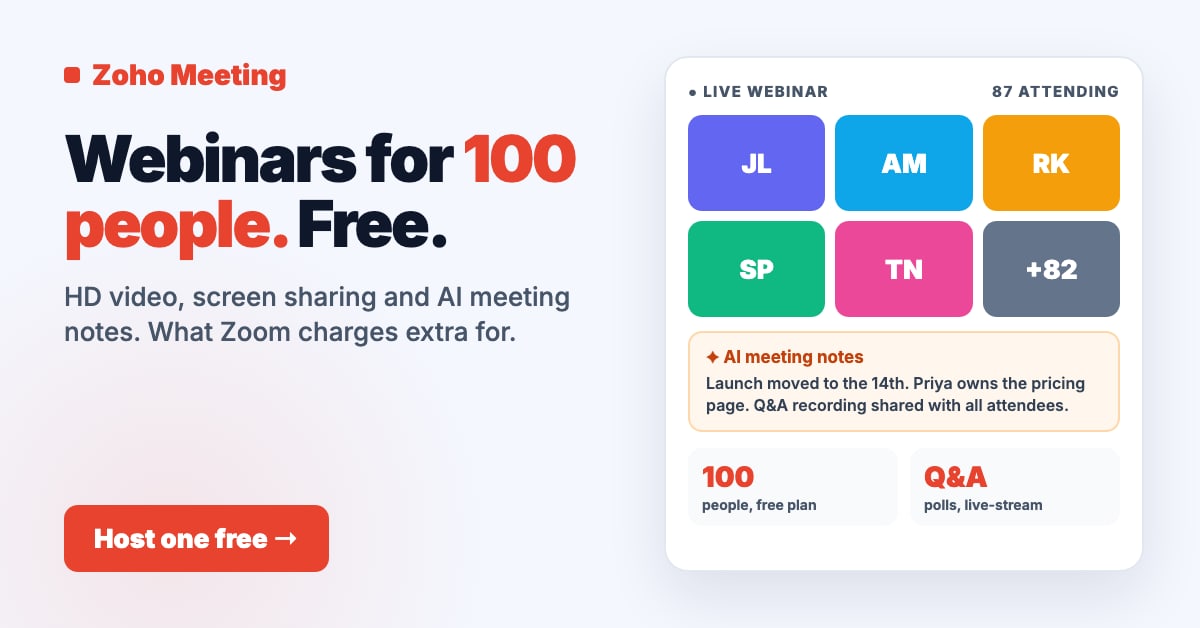
Meetings and webinars, free for up to 100 people. Zoho Meeting is a secure video platform that does what Zoom charges extra for. Full webinars, screen sharing, and AI-generated meeting notes.
• Free plan: HD video, screen sharing, and up to 100 participants per meeting or webinar
• AI-generated transcripts and summaries that capture the meeting so you don't take notes
• Real webinars. Registration forms, polls, Q&A, and YouTube live-streaming
Strategies & Tactics
> AI search strategy: 4 layers of brand visibility: Diagnose why AI assistants skip your brand by checking whether they can reach, correctly describe, trust, and cite your content before rewriting anything.
> How to build an AI agent: from goal to live deployment: Build one no-code AI agent for a repeatable task with clear goals and CRM data, then test and add human review before deploying.
> When a key search team member leaves: How to maintain continuity: Document the reasoning behind search decisions and ensure backup admin access now, so one person's departure doesn't sink your search performance.
> Your CEO wants answers your dashboard can’t give: Pair quick campaign metrics with deeper analysis of why customers buy, because only the latter answers the revenue and profit questions CEOs ask.
> Home Page vs Landing Page: Designing for the Bridge or the Destination: Design the home page as a bridge offering clear routes onward, but keep a landing page a focused dead end with one action.
> Why organic traffic can fall while revenue stays strong: AI-generated search answers cut informational clicks without hurting sales, so judge health by revenue and branded searches rather than raw organic traffic counts.
Other news you might like
- YouTube AI Search: What Gets B2B Videos Cited (Data) LINK
- AI boosts discovery but reviews still seal the deal, new research shows LINK
- Marketers hit with largest drop in consumer confidence since Covid LINK
- AI brand recommendations vary by platform and week: Study LINK
- Budget-limited campaigns lost their 20% ROAS surplus in 3 weeks, smec finds LINK
- YouTube’s Redesigned Mobile UI Puts Custom Feeds Front and Center LINK
Trending tools
OpenSEO: provides keyword research, competitor analysis, backlinks and site audits via MCP, feeding your AI agent real data for under $10 monthly. LINK
Articos: tests messaging, positioning, and landing pages against simulated personas matched to your ideal customer profile, delivering audience feedback in under 30 minutes. LINK
Tadata: an AI Slack assistant that connects your tools and sends daily briefings on meetings, contacts, and relevant news before work. LINK
dif.sh: open-source feature flags stored as markdown files beside your code, reviewed in pull requests, with context your coding agent reads automatically. LINK
Kombai Gallery: browse web and mobile UI designs across hundreds of categories, then remix them with Kombai or pass them to your coding agent. LINK
Web Search Agents by Nimble: domain-specific web crawling agents that self-learn your use case, pulling deeper, more relevant research context for company enrichment, regulations, and similar tasks. LINK
See you tomorrow for a new dose of ☕️ MarketingShot!